



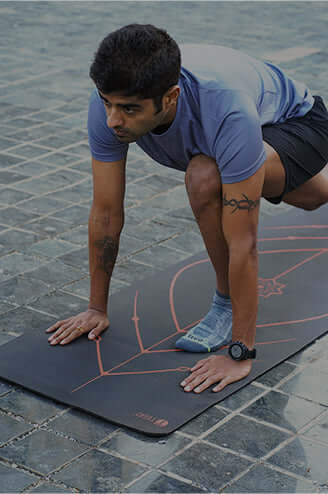

With Austin Varghese, Head Coach at Academy of Strength, Bengaluru.
If you’ve recently started running and are already dealing with tight hips, aching knees, or shin pain, chances are the issue isn’t just your running. It’s how your body is preparing for it.
In this quick mobility and activation session, Austin takes runners through a simple pre-run routine designed to:
-
improve hip and ankle mobility,
-
activate key stabilising muscles,
-
and reduce the chances of common running-related pain.
All you need is a yoga mat, resistance band and 10 minutes.
Why This Routine
Running is essentially repeated single-leg impact. If your hips, glutes, calves, and hamstrings aren’t doing their job properly, the stress usually shifts elsewhere — often to the knees, shins, or IT band.
This session focuses on fixing exactly that.
Rather than long static stretches, the routine combines:
-
mobility work,
-
muscle activation,
-
and stability exercises
to help your body move better before you start running.
What’s Covered in the Session
Warm-Up & Mobility
The session starts with movements like:
-
Cat-Camels
-
Downward Dog Marches
-
World’s Greatest Stretch
-
90/90 Hip Rotations
These help open up the spine, hips, calves, and hamstrings while improving joint movement and posture. For runners who spend most of the day sitting, this prep work can make a noticeable difference in how smooth and comfortable a run feels.
Glute Activation for Better Stability
One of the key focuses in the session is the glute medius — a small but important muscle on the side of the hip.
Exercises like Fire Hydrants and Single-Leg Glute Bridges help improve:
-
hip stability,
-
knee alignment,
-
and single-leg control.
Weak glutes are one of the biggest contributors to issues like knee pain and IT band irritation, especially as fatigue kicks in during runs.
Austin also highlights something many runners notice:
One side is usually less stable than the other.
Single-leg exercises help identify and gradually fix those imbalances.
Calves & Hamstrings: The Unsung Heroes of Running
The final part of the session targets the calves and hamstrings through:
-
Lunge Hold Calf Raises
-
Glute Bridge Walkouts
These exercises improve ankle stability, hamstring strength, and overall lower-body control — all essential for running efficiently and staying injury-free.
One key cue Austin repeats throughout:
Stay stable and controlled.
The goal isn’t speed. It’s quality movement.
The Takeaway
This isn’t meant to leave you exhausted before a run. It’s meant to prepare your body to run better. Done consistently — even 3–4 times a week — this short routine can help improve stability, reduce discomfort, and make running feel smoother overall.
So before your next run, spend 10 minutes getting your body ready for it. Your knees, hips, and shins will probably thank you later.
Watch the full mobility session with Austin Varghese, Head Coach at Academy of Strength, Bengaluru, below.


