



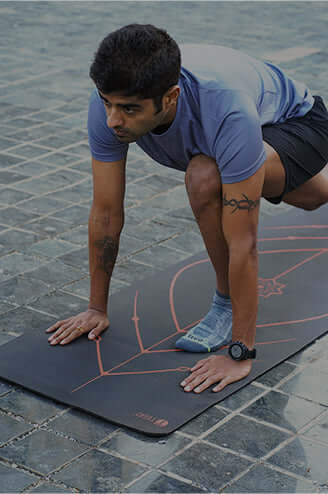

You can train hard for an hour and still spend most of your day sitting. So how much does that matter? The science offers a more nuanced answer than simply "exercise more."
The One-Hour Problem
You wake up, sit down for breakfast, commute to work, spend eight hours at your desk, drive home and then head to the gym.
You run. You lift. You cycle. You do yoga. For an hour, you're anything but sedentary. Then you go home and sit again.
This is the modern fitness paradox: you can exercise regularly and still spend most of your waking day sitting.
That's because exercise and sedentary behaviour aren't simply opposite ends of the same spectrum. Exercise is planned physical activity. Sedentary behaviour refers to waking time spent sitting or reclining while expending very little energy.
So, can one workout undo a day of sitting?
Not completely. But it can make a significant difference.
Exercise Helps. Sitting Still Matters.
A workout gives your body a concentrated dose of physical activity. Your heart rate rises, muscles contract, energy expenditure increases and your cardiovascular and muscular systems are challenged.
Prolonged sitting provides almost none of that stimulus.
This distinction matters because research has repeatedly found associations between high sedentary time and poorer health outcomes, including cardiovascular disease and premature mortality.
One of the largest studies to examine the relationship was a 2016 Lancet meta-analysis by Ekelund et al., which pooled data from more than 1 million people across 16 studies. The researchers found that mortality risk associated with high sitting time was substantially lower among people who were more physically active.
In the most active group—people accumulating roughly 60–75 minutes of moderate-intensity activity per day—the increased mortality risk associated with sitting for more than eight hours a day was no longer statistically significant.
That's an important finding.
But it doesn't mean a single workout gives you a free pass to sit for the rest of the day.
How Much Exercise Can Offset Sitting?
A more recent study gives us a useful, and slightly different, perspective.
In 2020, Ekelund et al. published a harmonised meta-analysis in the British Journal of Sports Medicine using accelerometer data from more than 44,000 middle-aged and older adults.
Unlike earlier studies that relied largely on self-reported activity, this analysis used device-measured movement.
The researchers found that around 30–40 minutes of moderate-to-vigorous physical activity per day was enough to substantially attenuate the association between high sedentary time and mortality. Among people achieving this amount of activity, the relationship between spending more time sedentary and higher mortality risk was no longer statistically significant.
But there's an important caveat: these are population-level associations, not proof that 30–40 minutes of exercise "cancels out" sitting for an individual.
Your health isn't determined by a single daily equation of sitting hours minus workout minutes.
What the research does tell us is that regular physical activity can substantially reduce the health risks associated with spending a lot of time sedentary.
So Why Not Just Exercise More?
Because your body responds to movement throughout the day, too.
A workout is one form of physical activity. Walking to lunch is another. Taking the stairs, standing up during a phone call or walking around between meetings are others.
These smaller bouts aren't substitutes for structured exercise. But they can reduce the amount of time you spend completely inactive.
A 2012 randomised crossover study by Dunstan et al., published in Diabetes Care, found that breaking up prolonged sitting with two-minute bouts of light or moderate walking every 20 minutes reduced post-meal glucose and insulin responses compared with uninterrupted sitting in overweight and obese adults.
The study was small—just 19 participants—and looked at short-term metabolic responses rather than long-term health outcomes.
But it illustrates an important principle:
You don't have to turn every movement break into a workout for it to matter.
Introducing NEAT - Think Beyond the Workout
This is where NEAT, or Non-Exercise Activity Thermogenesis, comes in.
NEAT describes the energy you use during everyday activities that aren't deliberate exercise: walking around the house, cooking, shopping, doing chores, taking the stairs or simply moving around during the day.
The amount varies significantly between people.
Two people could complete the same 45-minute workout but have very different total daily activity depending on how much they move for the other 23 hours.
That doesn't mean you need to track every step or turn daily life into another fitness challenge.
It means your workout isn't the only movement that counts.
What Should You Actually Do?
The World Health Organization's 2020 Guidelines on Physical Activity and Sedentary Behaviour recommend that adults accumulate 150–300 minutes of moderate-intensity aerobic activity per week, or 75–150 minutes of vigorous activity, alongside muscle-strengthening activity on at least two days per week. The guidelines also specifically recommend limiting sedentary time and replacing it with physical activity of any intensity.
Think of your day in layers.
Train
Get your structured exercise in. Run, lift, cycle, swim, practise yoga or play a sport.
Break Up Sitting
If your day involves long stretches at a desk, look for natural opportunities to stand and move.
Walk during a phone call. Take the stairs. Get up between meetings. Walk after lunch.
Move More
Don't underestimate ordinary activity. Walking to the store, doing household chores or taking a longer route home all contribute to your overall movement.
Recover
Rest still matters. Spending time sitting after a hard workout isn't inherently a problem. The goal isn't to eliminate sitting—it's to avoid spending the majority of your waking hours inactive whenever you have the opportunity to move.
The Answer Isn't "Work Out More"
The title of this article asks whether one workout can undo a day of sitting.
The more useful answer is this:
Your workout matters. So does everything around it.
Regular exercise can substantially reduce the health risks associated with high sedentary time, particularly when you're getting enough moderate-to-vigorous physical activity each week.
But you don't need to choose between training hard and moving more throughout the day.
Do both.
Train when it's time to train. Recover when you need to recover. And when you're working, travelling or going about your day, look for opportunities to move.
Because fitness isn't just what happens during your workout.
It's how you move through the rest of your day, too.
References
1. Ekelund U, et al. (2016). Does physical activity attenuate, or even eliminate, the detrimental association of sitting time with mortality? A harmonised meta-analysis of data from more than 1 million men and women. The Lancet, 388, 1302–1310.
2. Ekelund U, et al. (2020). Joint associations of accelerometer-measured physical activity and sedentary time with all-cause mortality: a harmonised meta-analysis in more than 44,000 middle-aged and older individuals. British Journal of Sports Medicine, 54, 1499–1506.
3. Dunstan DW, et al. (2012). Breaking up prolonged sitting reduces postprandial glucose and insulin responses.Diabetes Care, 35, 976–983.
4. World Health Organization (2020). WHO Guidelines on Physical Activity and Sedentary Behaviour.
5. Levine JA. (2002). Non-exercise activity thermogenesis (NEAT). Best Practice & Research Clinical Endocrinology & Metabolism, 16, 679–702.


